


























Views
Downloads



Skip Counting by 4s Worksheet | Essential Grade 2 Math
Paste this activity's link or code into your existing LMS (Google Classroom, Canvas, Teams, Schoology, Moodle, etc.).
Students can open and work on the activity right away, with no student login required.
You'll still be able to track student progress and results from your teacher account.
Strengthen early numeracy and prepare students for multiplication with this comprehensive skip counting by 4s resource. Designed to help Grade 2 learners identify patterns and build mental math speed, this worksheet set provides structured repetition through multiple visual formats. Students will gain confidence as they navigate 100-charts and sequence paths, ensuring they can recall these essential numerical intervals with accuracy and ease.
At a Glance
- Grade: 2 · Subject: Math
- Standard:
2.NBT.A.2— Count within 1000 and skip-count by 5s, 10s, and 100s- Skill Focus: Skip counting by 4s to 100
- Format: 4 pages · 8 tasks · Answer key included · PDF
- Best For: Independent math centers or morning work
- Time: 15–20 minutes
What's Inside
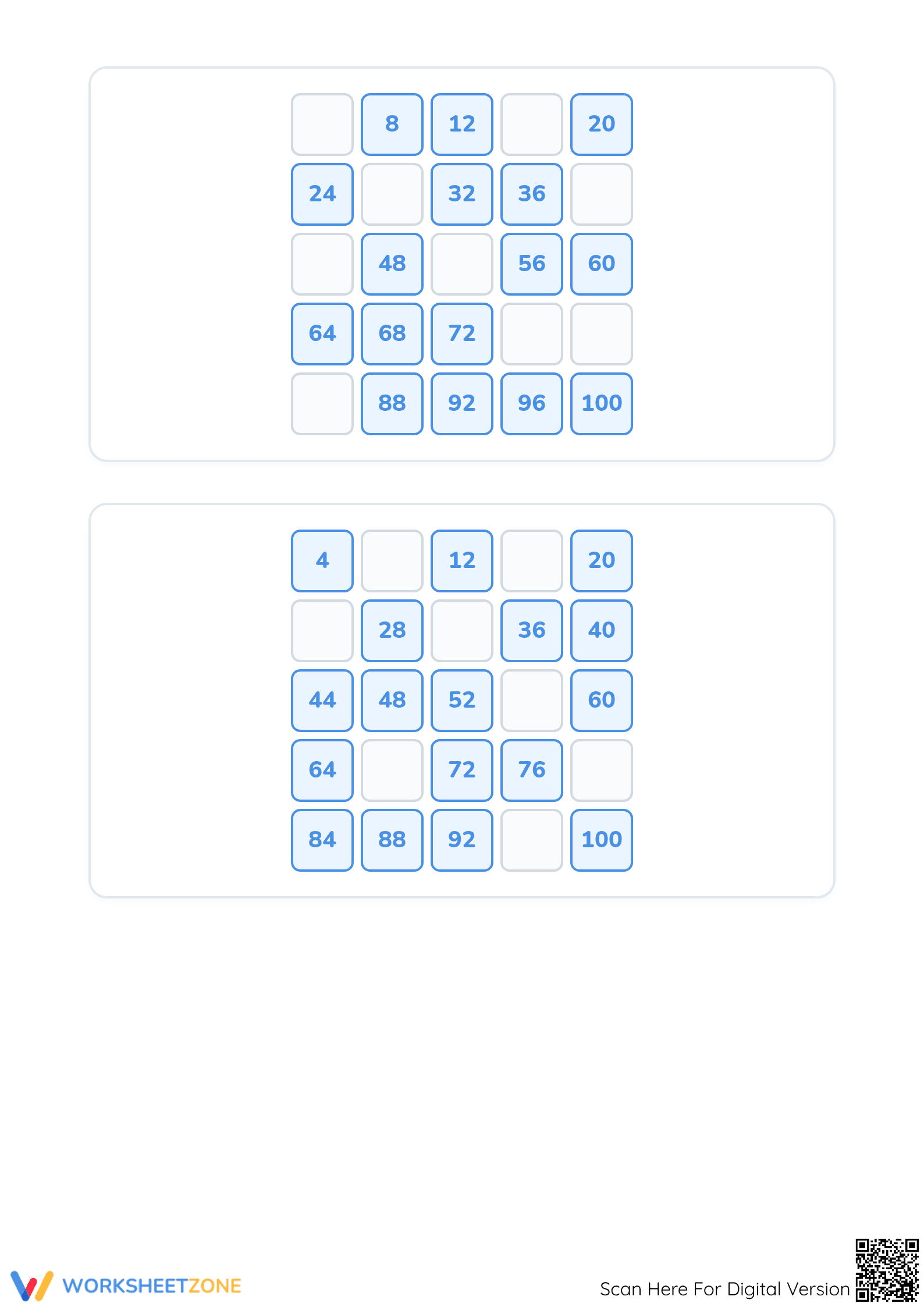
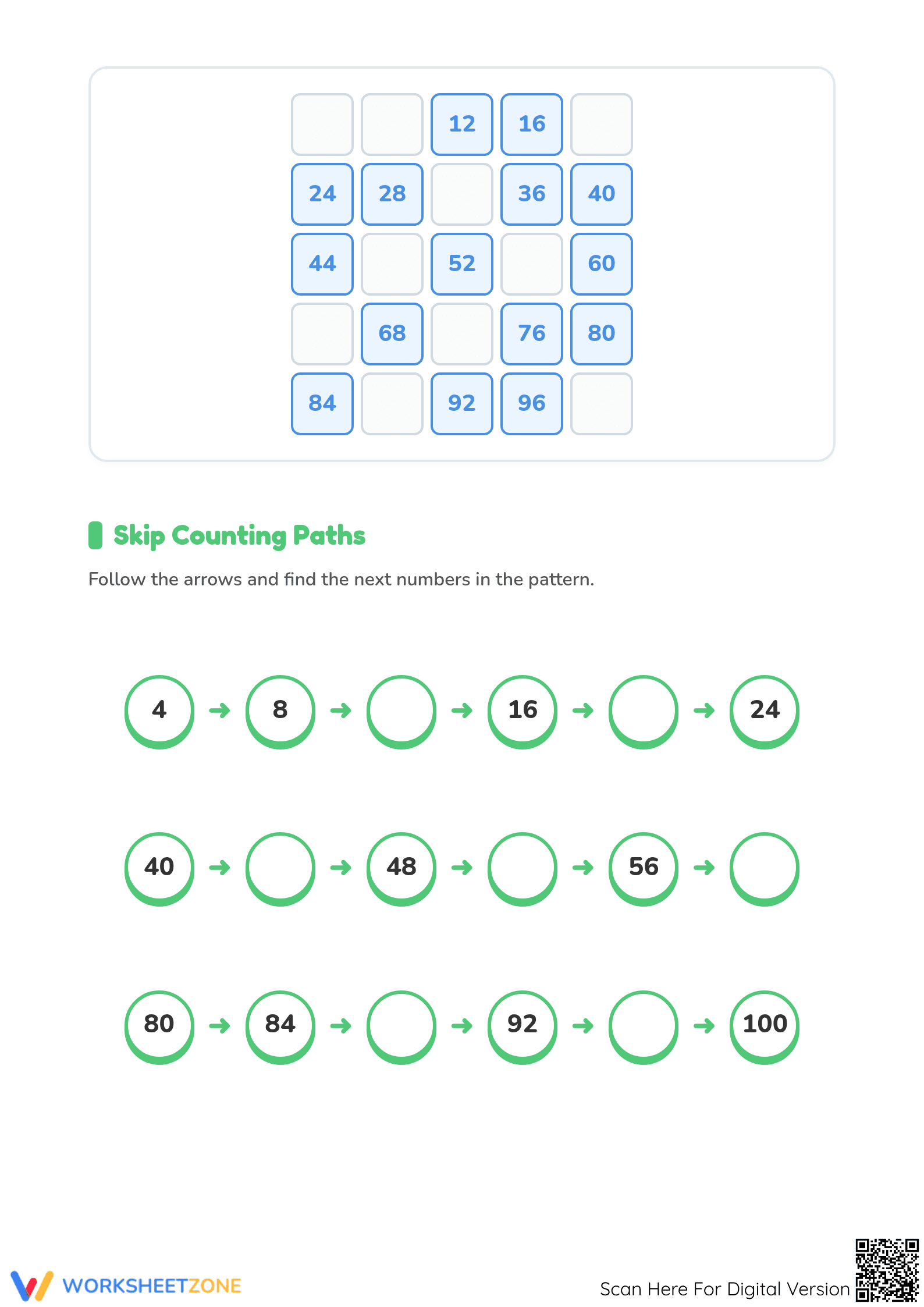
This four-page PDF includes five unique counting grids that vary in missing number density, challenging students to recall the sequence of 4s across different contexts. Additionally, the set features three "Skip Counting Paths" which use arrow-led circular sequences to reinforce linear pattern recognition. Each page is clearly labeled with space for name, date, and score, and a full answer key is provided for quick grading or student self-check.
Zero-Prep Workflow
- Print (30 Seconds): Select the specific page needed for today's lesson or print the full 4-page packet for a complete unit supplement.
- Distribute (1 Minute): Hand out the sheets as a low-stakes warm-up or as a focused task for early finishers.
- Review (1 Minute): Use the included answer keys to verify student work or project them for a whole-class check. Total prep time is under three minutes.
Standards Alignment
The primary focus is 2.NBT.A.2: "Count within 1000; skip-count by 5s, 10s, and 100s." While the standard emphasizes specific intervals, counting by 4s is an essential extension that bridges the gap toward 3rd-grade operations. This standard code can be copied directly into lesson plans, IEP goals, or district curriculum mapping tools to document progress in numerical fluency and pattern recognition.
How to Use It
Assign this worksheet during the "Independent Practice" phase of a lesson on number patterns. It serves as an excellent formative assessment; observe whether students are counting up by ones to find the next number or if they are beginning to internalize the multiples of four. For a different approach, use the "Big Challenge" grid on page four as a timed exit ticket to measure mastery at the end of the week.
Who It's For
This resource is tailored for second-grade students but is also highly effective for first-grade students ready for a challenge or third-grade students needing an intervention in multiplication readiness. It pairs naturally with a hundreds chart or a number line anchor chart, providing the necessary scaffolding for students who are still developing their skip-counting accuracy.
According to the RAND AIRS 2024 report on mathematics instructional materials, structured practice with non-standard skip-counting intervals, such as counting by 4s, is a critical bridge between additive reasoning and multiplicative thinking for early elementary students. This worksheet directly addresses CCSS.MATH.CONTENT.2.NBT.A.2 by challenging students to recognize and extend numerical patterns within a base-ten framework. By engaging with both linear paths and matrix-style grids, learners build the numerical fluency required for more complex operations. Research from Fisher & Frey (2014) emphasizes that the gradual release of responsibility, supported here by varying levels of scaffolding within the grids, leads to higher retention of mathematical sequences. For Grade 2 students, mastering the skip-counting sequence for 4s provides a foundational advantage when transitioning to third-grade multiplication and division concepts. This resource provides the rigorous, repetitive practice necessary to move these patterns into long-term memory, ensuring students can access these facts quickly during future problem-solving tasks.


